
 性能
性能
# 性能
Owner: -QVQ-
GPU设备信息查询
C:\Program Files\NVIDIA GPU Computing Toolkit\CUDA\v12.1\extras\demo_suite\deviceQuery.exe
Detected 1 CUDA Capable device(s)

Device 0: "NVIDIA GeForce RTX 3060 Ti"
  CUDA Driver Version / Runtime Version          12.1 / 12.1
  CUDA Capability Major/Minor version number:    8.6
  Total amount of global memory:                 8192 MBytes (8589410304 bytes)
  (38) Multiprocessors, (128) CUDA Cores/MP:     4864 CUDA Cores
  GPU Max Clock rate:                            1665 MHz (1.66 GHz)
  Memory Clock rate:                             7001 Mhz
  Memory Bus Width:                              256-bit
  L2 Cache Size:                                 3145728 bytes
  Maximum Texture Dimension Size (x,y,z)         1D=(131072), 2D=(131072, 65536), 3D=(16384, 16384, 16384)
  Maximum Layered 1D Texture Size, (num) layers  1D=(32768), 2048 layers
  Maximum Layered 2D Texture Size, (num) layers  2D=(32768, 32768), 2048 layers
  Total amount of constant memory:               zu bytes
  Total amount of shared memory per block:       zu bytes
  Total number of registers available per block: 65536
  Warp size:                                     32
  Maximum number of threads per multiprocessor:  1536
  Maximum number of threads per block:           1024
  Max dimension size of a thread block (x,y,z): (1024, 1024, 64)
  Max dimension size of a grid size    (x,y,z): (2147483647, 65535, 65535)
  Maximum memory pitch:                          zu bytes
  Texture alignment:                             zu bytes
  Concurrent copy and kernel execution:          Yes with 1 copy engine(s)
  Run time limit on kernels:                     Yes
  Integrated GPU sharing Host Memory:            No
  Support host page-locked memory mapping:       Yes
  Alignment requirement for Surfaces:            Yes
  Device has ECC support:                        Disabled
  CUDA Device Driver Mode (TCC or WDDM):         WDDM (Windows Display Driver Model)
  Device supports Unified Addressing (UVA):      Yes
  Device supports Compute Preemption:            Yes
  Supports Cooperative Kernel Launch:            Yes
  Supports MultiDevice Co-op Kernel Launch:      No
  Device PCI Domain ID / Bus ID / location ID:   0 / 1 / 0
  Compute Mode:
     < Default (multiple host threads can use ::cudaSetDevice() with device simultaneously) >

deviceQuery, CUDA Driver = CUDART, CUDA Driver Version = 12.1, CUDA Runtime Version = 12.1, NumDevs = 1, Device0 = NVIDIA GeForce RTX 3060 Ti
Result = PASS
1
2
3
4
5
6
7
8
9
10
11
12
13
14
15
16
17
18
19
20
21
22
23
24
25
26
27
28
29
30
31
32
33
34
35
36
37
38
39
40
41
SIMD(Single Instruction Multiple Data)一种技术模式,单指令流多数据流
SISD(Single instruction, Single data)单指令流单数据流 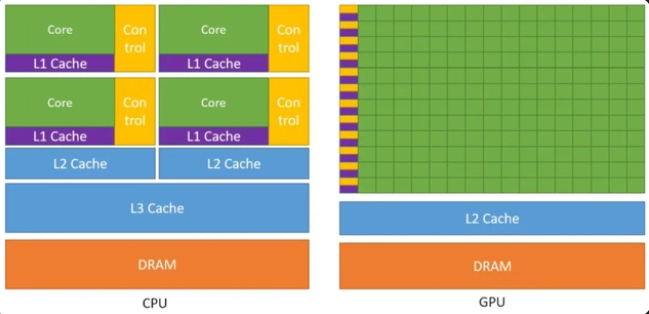
Device(物理上的GPU设备) = Grid(逻辑上的一个硬件文件)
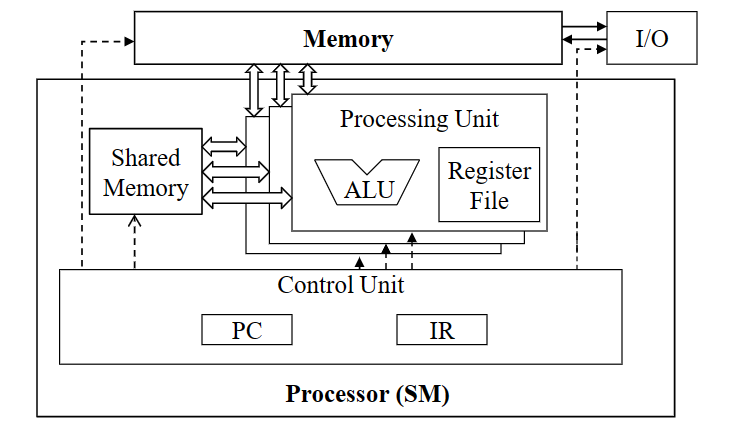
SM(Stream Multiprocessor, 流多处理器)=内核=逻辑架构里的CORE = (MP)Multiprocessor(硬件)= Thread Block
- Warp
- 加载存储单元(LD/ST)
- 特殊函数单元(SFU)
Warp(线程束):基本调度单元
- Core Warp编排器(Warp Scheduler)
- 分发单元(Dispatch Unit)
- sp在一个warp中执行SIMD
SP(Streaming Processor,流处理器)=CUDA Core=ALU= 线程
- 1个FPU(浮点数单元)
- 1个ALU(逻辑运算单元)

对于我的GPU,一个SM有32warp,一个warp有32个sp
多个SM组成的整体位SMs
GPU的 缓存结构:

对应英文register、shared memory、L1 cache、L2 cache、Texture memory 与C-Cache(常量缓存)、global memory
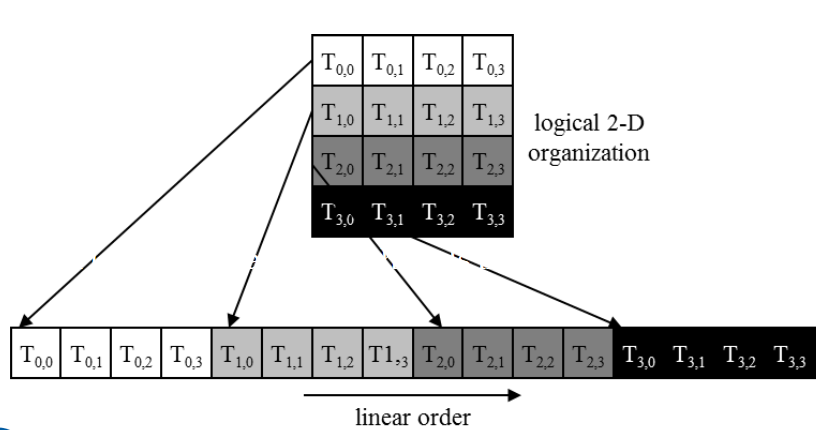
每个线程块按照x、y、z的一维线性的存储
SMs的运行模式
control divergence(控制分支):
因为wrap是基本调度单元,在执行if()语句的时候会创造两个不同的路径,但所有的wrap必须执行同一个路径,因此会产生两倍的耗时
处理控制分支带来的影响需要关注:
1边界检查(这些检查会导致显著的性能下降)
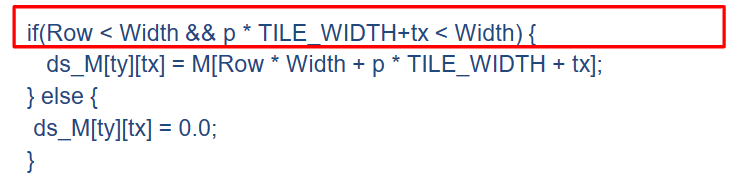
会产生如下两种类型的耗时影响

例如: 设处理100100的矩阵数据 设每个SM有8个warp,每个warp有32个sp,共256个sp(1616 tiles) 则,每行每列各需要7次才能遍历完,即第7次因为if()会产生控制分支 对于type 1,有6(行)*7(列)8(warp)=336个warp,共有3367=2352(每个warp会经历7个阶段)个warp阶段,共有6个矩阵(橙色部分)会产生一倍的控制分支即336 对于type 2,有1(行)7(列)8(warp)=56个warp,共有567=392(每个warp会经历7个阶段)个warp阶段,仅有最后一个块会产生一部分控制分支27=14个控制分支 所有性能影响为(336+14)/(2352+14)12%
可以将边界检查变为数据的计算
//原代码
if(a > 10) a=a+1;
//优化后
a = (a/10) * 1 + a;//a如果小于10,a = 0 + a, 如果大于10小于20, a = 1 + a
2
3
4
2所处理的数据本身
并行规约(parallel reduction):一种线程并行计算的重要方法
在处理没有关联的数据时,将数据划分成更小的块,每个线程分别计算这些块,再将结果汇总到一起
规约树
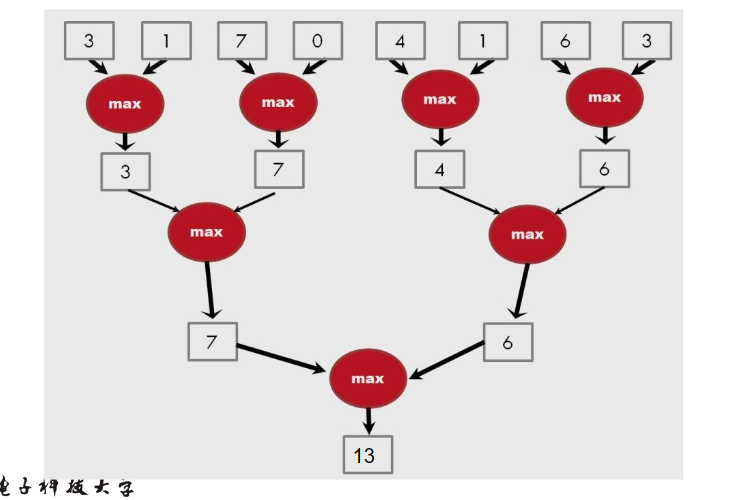
对于N个数据,如果有足够的资源,平均并行度为(N-1)/log(N)
当N足够大时需要大量的资源,这是低效的
故大多数并行算法并不一定有效,在设计并行算法时要考虑处理的数据规模量